What Fees Does Airbnb Actually Charge Hosts?
Airbnb’s Host Service Fee Explained Airbnb’s split-fee host service fee is approximately 3% of the booking subtotal, deducted automatically from your payout before the money reaches your bank account. Important update: as of late 2025, Airbnb consolidated most hosts onto a single “host-only” fee of roughly 15.5% and eliminated the separate guest service fee for ...

Airbnb’s Host Service Fee Explained
Airbnb’s split-fee host service fee is approximately 3% of the booking subtotal, deducted automatically from your payout before the money reaches your bank account. Important update: as of late 2025, Airbnb consolidated most hosts onto a single “host-only” fee of roughly 15.5% and eliminated the separate guest service fee for them — the 3% split-fee model now applies only to independent hosts who self-manage without connected software (we break down both below). This fee covers Airbnb’s platform infrastructure, payment processing, customer support, and the marketing that drives guests to the platform where they find your listing.
THE BOTTOM LINE
As of late 2025, Airbnb moved most hosts to a single host-only fee of about 15.5% of the booking subtotal, with guests seeing no separate service fee. The older split-fee model (roughly 3% to the host, ~14% to the guest) now survives only for independent hosts who self-manage without connected software. Any Maine owner on professional management — including Everrow — falls under the host-only fee, so the goal is to factor that ~15.5% into a dynamic pricing strategy rather than treat it as optional.
For a practical example, let’s say you own a property in Portland, Maine and a guest books a three-night stay at $225 per night. The booking subtotal is $675. Your host service fee would be approximately $20, meaning your payout would be around $655 before any cleaning fee adjustments.
It’s important to understand that this fee is calculated on the booking subtotal — your nightly rate multiplied by the number of nights, plus your cleaning fee and any extra guest fees you’ve set — but not on taxes or Airbnb’s own fees. The cleaning fee is part of that subtotal, so the service fee applies to it as well; it does not pass through to you fee-free.
Airbnb processes payouts typically within 24 hours of guest check-in, minus the host service fee. Depending on your payment method and financial institution, the actual deposit may take an additional one to five business days to appear in your account.
One aspect that catches some hosts off guard is how the fee interacts with cancellations. If a guest cancels and receives a full refund under your cancellation policy, Airbnb refunds your host fee as well. But if the cancellation is partial (say, the guest shortens a week-long stay to three nights), the fee is recalculated on the reduced amount. Under certain cancellation policies, particularly strict ones, you may retain a portion of the booking while the guest receives a partial refund, and your host fee applies only to the amount you actually receive.
| Fee Type | Who Pays | Amount |
|---|---|---|
| Host Service Fee (Split) | Host | 3% |
| Guest Service Fee (Split) | Guest | ~14% |
| Host-Only Fee (Current Standard) | Host | ~15.5% |
| Currency Conversion | Guest (if applicable) | ~1–3% |
Simplified Pricing (The Host-Only Fee Model)
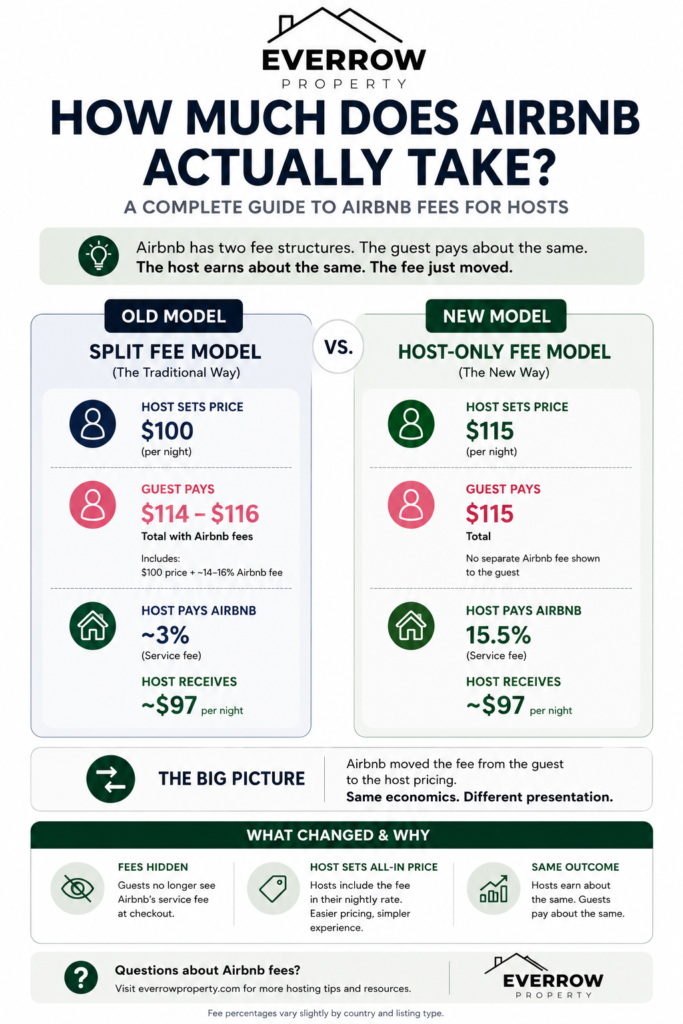
Airbnb offers an alternative fee structure called simplified pricing, also known as the host-only fee model. Under this structure, you as the host absorb the entire service fee — now standardized at roughly 15.5% of the booking subtotal (it had previously been described as a 14–16% range). In exchange, guests see a single, all-inclusive price with no separate service fee added at checkout.
The math looks very different from the split-fee model. On that same Portland booking at $225 per night for three nights ($675 subtotal), a 15% host-only fee would be approximately $101, compared to the roughly $20 you’d pay under the split-fee model. Your payout drops from $655 to approximately $574.
So why would any host voluntarily pay five times more in fees? The answer comes down to booking conversion and search visibility. When guests compare listings, many filter and sort by total price, which includes the guest service fee. Under the split-fee model, your $225 per night listing actually costs the guest $255 or more after their fee is added. Under simplified pricing, the guest sees exactly $225 with nothing extra added.
This price transparency advantage means your listing appears more competitively priced in search results and during the booking comparison process. Airbnb has also indicated that listings using simplified pricing may receive preferential treatment in search algorithms, though the exact impact is difficult to quantify.
Many professional hosts and property management companies have found that the increase in bookings generated by simplified pricing more than compensates for the higher fee. The key is to factor the fee into your nightly rate from the start. Instead of listing at $225 under the split-fee model, you might list at $260 under simplified pricing. The guest sees $260 all-in rather than $225 plus $35 in fees, and your net payout is similar while the guest has a better booking experience.
One important caveat as of late 2025: this is no longer a free choice for everyone. Airbnb now requires the host-only fee for any listing connected through property management software or a channel manager — which covers virtually all professionally managed properties — while independent hosts who self-manage without software can still opt for the split-fee model. Where you do have a choice, whether simplified pricing makes sense for your property depends on your specific market, competition, and pricing strategy. In competitive Portland neighborhoods where guests have many options at similar price points, the conversion advantage of simplified pricing can be significant.
Additional Fees and Costs Hosts Should Factor In
Beyond Airbnb’s service fee, several additional costs eat into your rental income. Understanding all of them is essential for setting a nightly rate that actually generates the profit you’re expecting.
Cleaning fees are one of the most visible costs to guests, and how you handle them affects both your revenue and your booking rate. You set the cleaning fee yourself, and it appears as a separate line item on the guest’s booking total. Most Portland hosts charge between $100 and $200 for cleaning, depending on the property size. The cleaning fee is included in the booking subtotal that Airbnb’s service fee is calculated on, so a percentage is deducted from it just as it is from your nightly rate — it does not pass through fee-free. However, a high cleaning fee can deter guests, particularly for short stays where the per-night impact is significant. A $150 cleaning fee on a one-night stay effectively adds $150 per night, but on a seven-night stay, it’s only about $21 per night.
Maine taxes apply to short-term rentals and are collected and remitted by Airbnb in most cases. Maine’s lodging tax is a flat 9% statewide; unlike some states, Maine does not authorize separate municipal lodging taxes, so there is no additional Portland-specific lodging rate on top of the 9% (Portland does, however, require annual short-term rental registration and fees). These taxes are added to the guest’s total and don’t come out of your payout, but they increase the all-in price the guest sees, which can affect booking behavior. Understanding your total tax obligation is important for financial planning and compliance.
Currency conversion fees apply if you receive bookings from international guests and your payout currency differs from the booking currency. For Maine properties, this is most commonly relevant for Canadian guests from Quebec and the Maritimes, who make up a meaningful portion of the tourism market in certain areas. Airbnb charges a conversion fee of approximately 2-3% on these transactions.
Payment processing costs are bundled into Airbnb’s service fee, so there’s no additional credit card processing charge. However, if you receive payouts via PayPal instead of direct deposit, PayPal may charge its own fees on top of Airbnb’s.
Insurance and liability considerations are an indirect cost that many hosts overlook. Airbnb provides AirCover for hosts, which includes up to $3 million in damage protection and $1 million in liability coverage. However, AirCover has exclusions and limitations, and many property owners carry additional short-term rental insurance to fill the gaps. This added insurance cost should be factored into your revenue calculations. Visit our frequently asked questions for more on protecting your property.
Tired of fee complexity cutting into your returns?
Everrow handles all platform fee strategy, pricing optimization, and financial reporting.
How Fees Impact Your Pricing Strategy
Understanding fees isn’t just an academic exercise. It directly determines how you should set your nightly rate. The mistake most self-managing hosts make is setting a rate based on what looks competitive without accounting for the full fee structure, then being disappointed when their actual payout is lower than expected.
Here’s how to think about pricing with fees in mind. Start with your target payout: the amount you want to receive per night after all fees. If your goal is to net $200 per night, you need to work backward through the fee structure to determine what nightly rate achieves that payout.
Under the split-fee model with a 3% host fee, you’d need to list at approximately $206 per night to net $200. Under the host-only fee of roughly 15.5%, you’d need to list at approximately $235 per night to achieve the same net payout. The guest’s total cost will be different under each model (because the guest fee is eliminated under simplified pricing), which affects your competitive position differently.
The more sophisticated approach is to think not about a target per-night payout, but about a target annual net revenue. This shifts the focus from optimizing a single number to optimizing the overall system: rate, occupancy, fee structure, and platform strategy working together.
For example, listing at $235 per night under simplified pricing might generate more bookings than listing at $206 under split-fee pricing, because guests see a lower total cost at checkout. Even though your per-booking margin is thinner, the higher volume can produce more total income. This is the kind of analysis that requires real booking data and market context, and it’s one of the many areas where a professional property manager provides value.
Dynamic pricing tools factor fee structures into their rate recommendations automatically, optimizing for your net revenue rather than just the headline nightly rate. If you’re setting prices manually without accounting for fee interactions, you’re almost certainly not optimizing effectively. A professional property management approach handles all of this complexity for you.
Let a Property Manager Handle the Complexity
Fee structures, tax compliance, pricing optimization, and multi-platform management create genuine operational complexity for property owners. Each platform has its own fee model (we compare Airbnb vs. VRBO fees here), its own rules, its own best practices, and its own evolving policies. Staying on top of all of it while also running the day-to-day operation of your rental is a significant time investment.
This is one of the core reasons professional property management exists. A skilled manager handles fee optimization as part of a comprehensive revenue strategy. They know which fee model performs best in your specific market, how to set rates that account for all platform and operational costs, when to adjust strategies as platforms change their policies, and how to maximize your net revenue across multiple channels simultaneously.
At Everrow Property, we manage short-term rentals across Portland, Old Orchard Beach, Sugarloaf, Sunday River, and other Maine markets. Fee optimization is just one element of our comprehensive approach, which also includes dynamic pricing, multi-platform listing management, professional photography, guest communication, cleaning coordination, maintenance management, and financial reporting.
For Maine property owners, the value proposition is straightforward: we handle the complexity so you don’t have to, and the revenue improvement typically more than covers the management fee. Your property earns more, you spend less time managing it, and you have a clear view of your financial performance through regular reporting.
If you’re unsure whether your current fee strategy is optimal, or if you’re tired of keeping up with platform changes and fee adjustments, our Revenue Estimator can show you what your property could earn under professional management. From there, a conversation with our team can help you decide whether professional management is the right move for your situation.
See your net revenue potential — fees included
Our free estimator projects what your Maine property could earn after all platform costs.
Find out what your Maine property could earn.
Our revenue team builds a custom projection for your home using comparable rentals, seasonal demand, and the operational levers most owners overlook. No obligation, no high-pressure follow-up.